February 8, 2025
Renovation tips
Rules I abide by to survive renovations
I recently watched a few videos about renovation projects with costs reaching up to the actual value of the property itself, and even exceeding it. And it reminded me of the days when I was a travel blogger. Back in the days when everyone thought constant travel was only the rich person's domain I took it my goal to disprove it and show how you could move and live around the world with just around $600 per month.
Today I see companies claim that the renovation costs start from the number which is nearly twice the maximum amount of what I've paid for one of my most expensive projects. And that's the lowest tier for them! I image it can make some people sad thinking they can never afford beautiful homes. And again, I consider it my duty to say: this is not true.
We live in the world of capitalism where nothing is free. Except time, our own time. The resource of time we are born with, a gift from the universe. As we live we exchange that time for money in order to get the things we need for survival or just want to have for fun. And it's crucial to understand that when you hire people to do things for you, you have to pay for all their time. And when you hire a company, you have to contribute to their office lease (if any), all their employees salaries, their marketing budget, etc, etc. And only a part of what you will pay them for your renovation will be the cost of your actual renovation.
So here are some key points on how to cut the renovation costs significantly.
1.Be aware of your own time as a resource, and other peoples' time as a paid resource also. Can you be your own designer? Can you paint your walls, cut and glue your moldings? Assemble your furniture? How does their hourly rate compare with your own hourly rate? My own rule is, I pay the rates which are significantly higher than my own only for the tasks I absolutely cannot do by myself.
2.Be aware that the larger company is, the more resources it requires just to function. The rules of software companies do not translate to construction companies in the same manner. Large software company basically creates one product which many people share. And so, for the fraction of the development cost paid as a monthly subscription, you can have access to a very sophisticated infrastructure. Home renovation is highly individual service, and though some decisions can be streamlined, it still has be to done by actual people in your actual space. So the best bet to cut costs is hiring individual constructors or smaller teams. So you don't pay their secretary, their cleaner and the lease of their office.
3.Look for highly discounted premium décor and materials. There are, obviously, phony brands with artificially elevated prices, there are items which are expensive just because they are imported with high import taxes, but in most cases objects which are on a significantly higher price tier do have an undeniable aesthetic value. So try to find them used, try to find them slightly damaged, try to find them heavily discounted just because that actual one color was not the most popular. And if you are your own designer, be flexible and find your solutions based on these unique finds.
4.Accept imperfections. When something is brand new and you damage it for the first time, it may feel almost like a wound, except this wound won't heal by itself. But let it be. Read about Japanese Wabi Sabi, study Zen philosophy and the Great Perfection of Dzogchen from Tibet. And embrace the imperfection. Time leaves its marks on everything, and there's nothing bad about that. The highly glossy image perpetuated through media is highly artificial. Don't let them fool you, rebel and embrace the imperfect.
5.Be flexible. Your construction worker will hate you for every change, so the best thing is not to tell them much ahead of the nearest steps that they have to implement. But in your head, be ready to change and rework a lot. Lucky case, if you get your hands on discounted premium materials, or unlucky case, if something is done in a very wrong way and changing it will not only steal your budget but will waste a lot of time. So just learn to accept these changes.
What will not happen? Your project will most likely not be exactly as you've envisioned it. At some point it will become a thing of its own, almost like an entity with its own life, almost like a child. You will still love it. But what also will not happen, you will not be deep in debt. You will not waste the precious time of your life working long hours to pay for what could easily be cut.
But what will happen, you'll be happy but totally exhausted. So try to plan for a holiday as well. Just don't book your tickets ahead of completion or you may end up like me: painting walls and assembling furniture for 12 hours every day, and not even having time to take pictures of the final result.
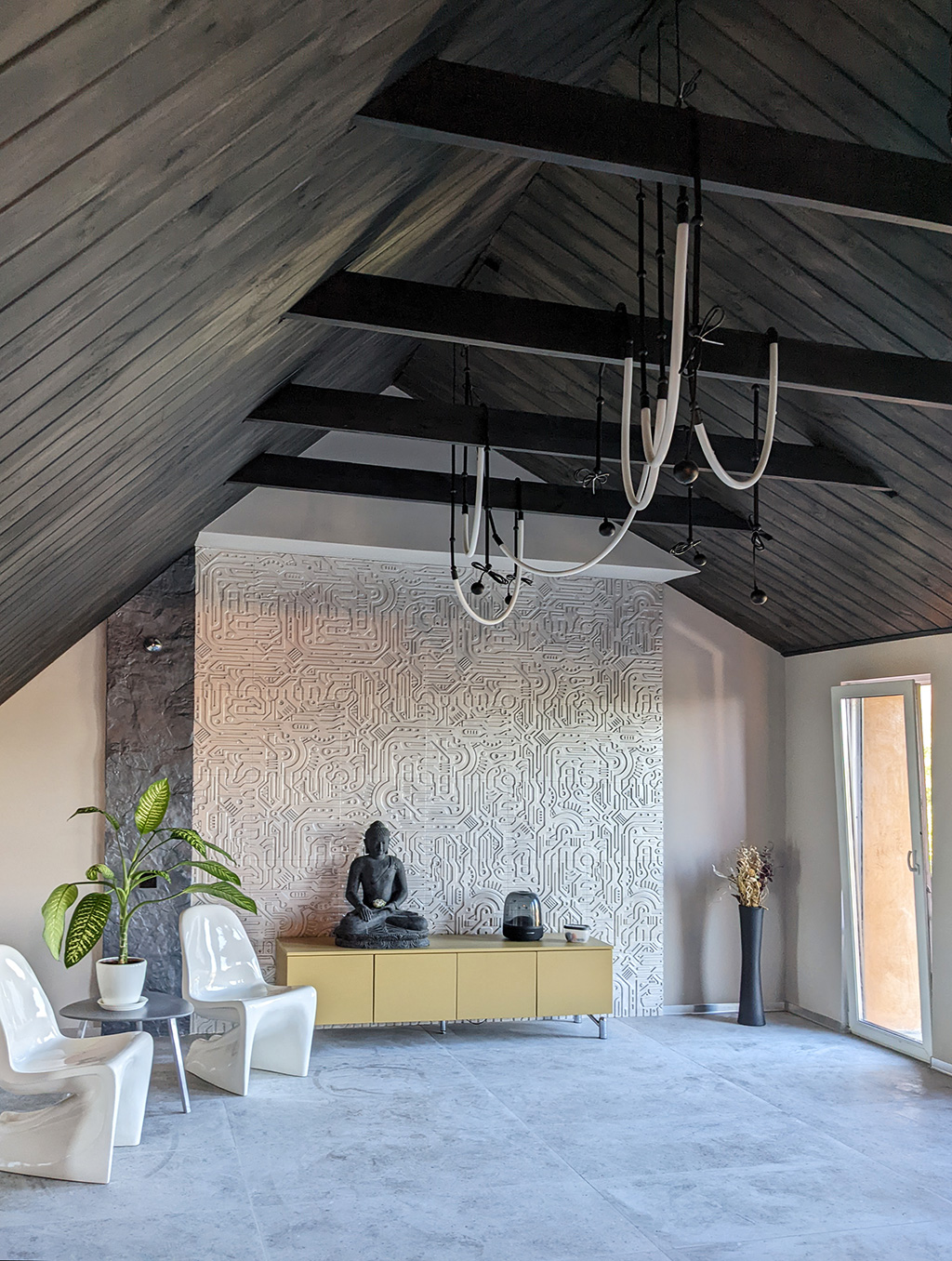
And I'll illustrate it with the only two decent photos that I have of the project I completed last year. And which I also have paid off completely last year, and not so much because I have good earnings, but mostly because I've planned it very well.
One of unique items I managed to find was Her chair by Fabio Novembre, original, for a fraction for the price. And you can see me gleefully grabbing that bum on the photo.